A Cleaner Way to Pass Navigation Arguments in Navigation 3
Recently I came across an interesting article about using Hilt Assisted Injection with Jetpack Navigation 3 instead of relying on SavedStateHandle for passing navigation arguments to a ViewModel.
The idea is simple: rather than having a ViewModel read navigation arguments from SavedStateHandle, pass the route object directly through Assisted Injection.
The Traditional Approach
For a long time, many Android apps have used SavedStateHandle to retrieve navigation arguments:
class DetailViewModel(
    savedStateHandle: SavedStateHandle
) : ViewModel() {

    private val route = savedStateHandle.toRoute<DetailRoute>()
}
This works well, but it also means the ViewModel knows about navigation-specific APIs.
Conceptually, the dependency flow looks like this:
Screen
  ↓ navigate()
Navigation
  ↓
SavedStateHandle
  ↓
ViewModel
Downsides
- The
ViewModeldepends on Navigation APIs. - Testing often requires setting up a
SavedStateHandle. - Navigation concerns leak into the presentation layer.
- Route changes can affect ViewModel implementation details.
The Navigation 3 Approach
With Navigation 3, the recommended pattern is to inject the route directly into the ViewModel.
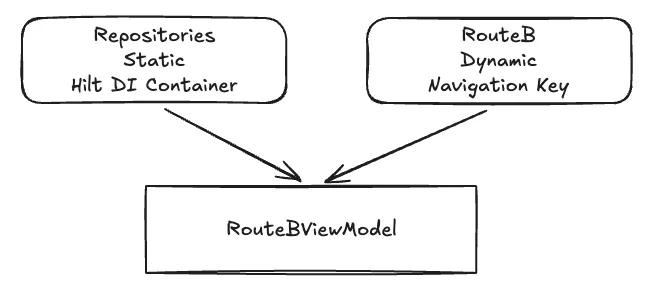
@HiltViewModel(assistedFactory = DetailViewModel.Factory::class)
class DetailViewModel @AssistedInject constructor(
    repository: Repository,
    @Assisted val route: DetailRoute
) : ViewModel()
The dependency flow becomes much simpler:
Screen
  ↓
Route
  ↓
Assisted Injection
  ↓
ViewModel
Benefits
- The
ViewModelonly knows about the route data it needs. - Less coupling to Navigation APIs.
- Easier unit testing.
- Better separation of responsibilities.
- Works naturally with dependency injection.
Example
Route
@Serializable
data class Detail(
    val userId: String
) : NavKey
ViewModel
@HiltViewModel(assistedFactory = DetailViewModel.Factory::class)
class DetailViewModel @AssistedInject constructor(
    @Assisted private val key: Detail,     // dynamic
    private val repository: UserRepository // static
) : ViewModel() {

    private val _state = MutableStateFlow<User?>(null)
    val state: StateFlow<User?> = _state

    init {
        viewModelScope.launch {
            _state.value = repository.getUser(key.userId)
        }
    }

    @AssistedFactory
    interface Factory {
        fun create(key: Detail): DetailViewModel
    }
}
UI (Composable)
NavDisplay(
    backStack = backStack,
    entryDecorators = listOf(
        rememberSaveableStateHolderNavEntryDecorator(),
        rememberViewModelStoreNavEntryDecorator()
    ),
    entryProvider = entryProvider {
        entry<Detail> { key ->
            val viewModel = hiltViewModel<DetailViewModel, DetailViewModel.Factory>(
                creationCallback = { factory ->
                    factory.create(key)
                }
            )
            DetailScreen(viewModel = viewModel)
        }
    }
)
@Composable
fun DetailScreen(
    viewModel: DetailViewModel
) {
    val user by viewModel.state.collectAsStateWithLifecycle()

    Box(
        modifier = Modifier.fillMaxSize(),
        contentAlignment = Alignment.Center
    ) {
        Text(user?.name ?: "Loading...")
    }
}
Comparing the Two Approaches
| Aspect | SavedStateHandle | Assisted Injection |
|---|---|---|
| Type safety | ✅ | ✅ |
| Testability | ⚠️ | ✅ |
| Navigation coupling | High | Low |
| ViewModel independence | Lower | Higher |
| DI friendliness | Good | Excellent |
Why I Like This Pattern
A ViewModel should primarily manage UI state and business logic.
When it also becomes responsible for retrieving navigation arguments, responsibilities start to overlap.
ViewModel
 ├ Navigation argument retrieval
 ├ State management
 └ Business logic
With Assisted Injection:
Navigation
 └ Route creation

ViewModel
 ├ State management
 └ Business logic
The responsibilities are much clearer.
Things to Keep in Mind
SavedStateHandle.toRoute()is still supported and perfectly valid.- Navigation 3 is relatively new, so patterns may continue to evolve.
- Assisted Injection introduces a bit more setup code.
- For smaller apps, the practical difference may be minimal.
Final Thoughts
The biggest takeaway for me is this:
Navigation 2
→ ViewModel reads arguments from SavedStateHandle

Navigation 3
→ Route is injected directly into the ViewModel
It’s a small architectural shift, but it helps keep ViewModels focused on what they should be doing: managing state, not dealing with navigation infrastructure.